
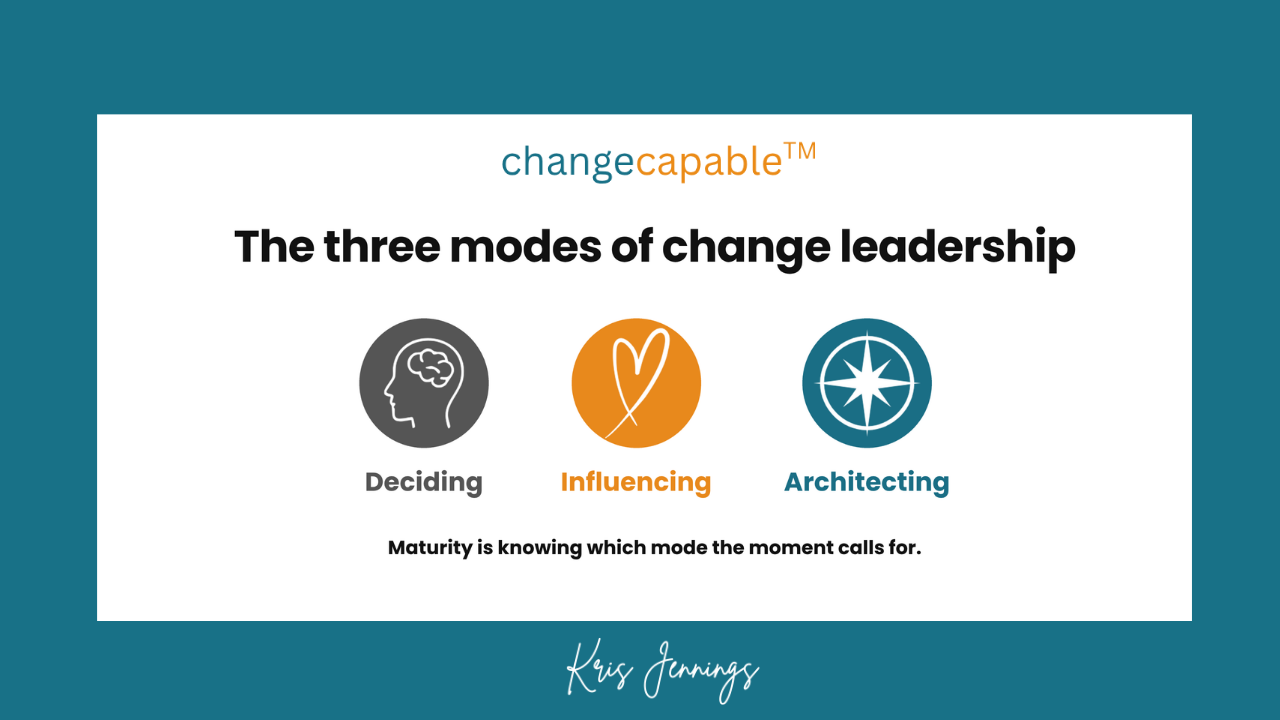
The three modes of change leadership
May 11, 2026This post first introduced the three modes as the Influence Stack. They’re now the heart of the changecapable™ method: three modes leaders move between.
Organizational change is not immune to change. Right now, the field itself is being disrupted, because AI is automating the delivery of change management work.
The tasks that once justified large change teams and weeks of leader prep are increasingly done in minutes. Drafting stakeholder communications. Synthesizing progress updates. Building training calendars. Producing readiness dashboards. AI handles that layer well.
So here is the question worth sitting with. What is AI automating, and what has to stay human?
AI is automating the logistics layer of change management: producing and delivering information. That is managing the work, not leading people. Traditional change management built a whole discipline around this layer, and it brought useful rigor to the people side of projects.
But that layer is not what moves people. It never was.
I have made the fuller case for why the people work cannot be handed off or automated in You can’t outsource change leadership. This piece is about what that people work is made of, and how a leader builds the skill to do it.
The organizations struggling most with the big shifts, including AI adoption and restructuring, are often the ones doubling down on the old layer. Working harder at logistics, or squeezing cost out of it, and hoping better communication will finally produce behavior change. It will not. The logistics layer was never the engine of adoption.
For three decades I have watched leaders reach for more information when change stalls. More data. A clearer business case. Another deck. When that does not work, they do it again, louder. It rarely works, because behavior change was never a knowledge problem. Now that AI has taken the logistics off the table, that is impossible to ignore.
What is missing is not better information. It is a different way of leading, and it is the part AI cannot replicate.
The three modes
Across my work advising leaders through transformations, launches, and restructurings, and through developing the changecapable method, I have come to describe change leadership as three modes. They are the heart of the changecapable method.
- Deciding: making the call, with people in mind.
- Influencing: moving people through emotion, story, and relationships.
- Architecting: making the new way the easy choice, and the one that sticks.
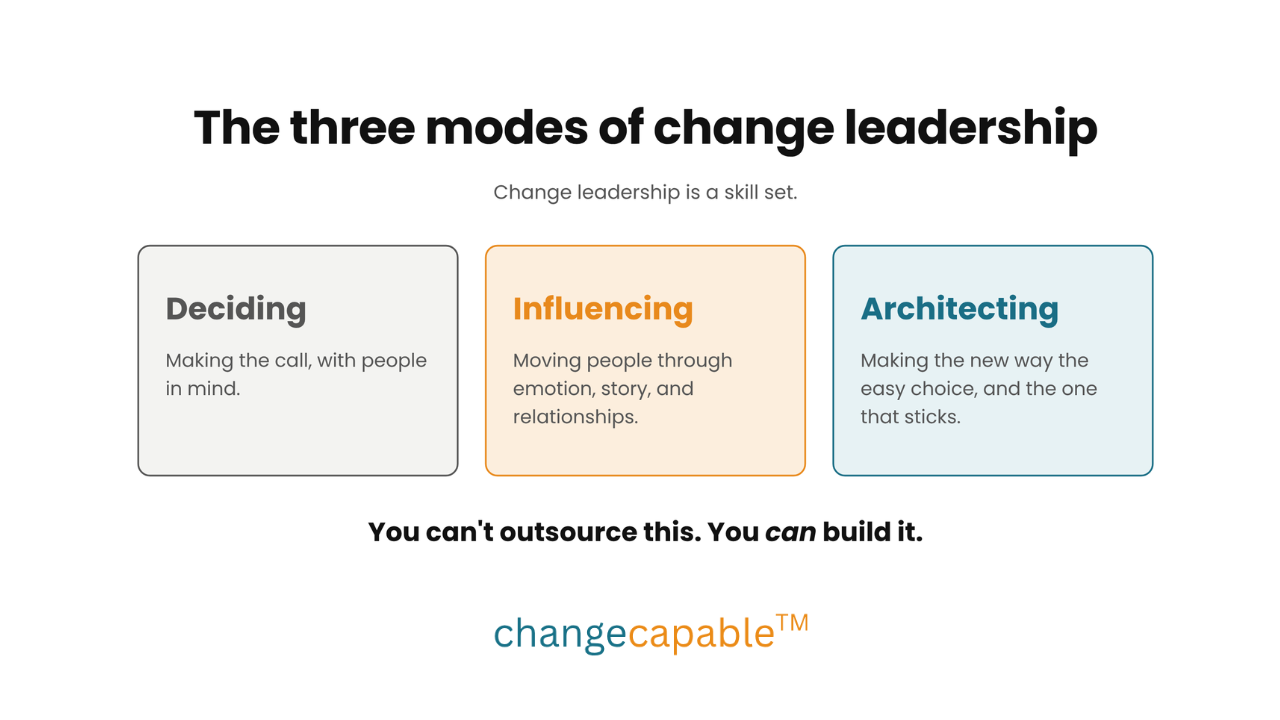
I hold this as a working model, not a settled law. The modes are not a ladder. Leaders move between them, and maturity is knowing which mode a moment calls for: the decision, the emotion, or the design. Whether the three hold together this cleanly is one of the questions my research is built to answer. More on that below. First, what each mode is.
Deciding mode
Making the call, with people in mind.
Deciding is the leader’s own judgment during change. Which way to go when things stall. Who has the final say and who is only advising. Where to put your attention. How much weight the people side gets next to time and cost.
Most leaders are trained to decide on the business case alone. A leader in this mode tests their reasoning against opposing views, makes a call when waiting would cost more than being wrong, and counts the people impact before committing, not after.
That is already a real step beyond communicating more clearly. And it is only one of three modes.
Influencing mode
Moving people through emotion, story, and relationships.
Influencing is the emotional and relational work of change. Read the emotion, shape the story, move from reaction to response.
Behavior change is emotional before it is rational. Resistance is not a communication failure. It is a signal about what people are losing and what they need from the person leading them. A leader in this mode treats emotion as information, leads through story as much as logic, and builds the relationships that make people willing to move. This is also where influence without formal authority lives, which matters because most change is led by people who cannot fall back on hierarchy.
My book, Inspired by Fear: Becoming a Courageous Change Leader, is about the shift into this mode.
Architecting mode
Making the new way the easy choice, and the one that sticks.
Architecting treats behavior change as a design problem. Design the path that makes the new behavior the easy, natural choice, and design for it to hold. It starts with the choices themselves: naming what the change asks people to choose, giving them real options, and making the new way the default.
A leader in this mode asks less “how do I convince people” and more “how do I shape the environment so the right behavior is the default, and so it lasts after the attention moves on.” That is the difference between adoption and sustained change. I suspect it is the rarest of the three modes, and the one that produces the most durable results, including with AI adoption. Both are things I want the research to confirm or correct.
You cannot explain an organization into a new way of working. You can design for it.
What change leadership maturity looks like
Early on, I pictured the three modes as a ladder. My fall leadership program and the research so far have shown me something more useful.
Maturity isn’t a rung you reach. It depends on two things: how complex the change is, and the role you play in it.
A bigger, more complex change asks more of every mode. More people to weigh, more emotion in the room, more steps that can trip people up. It also gives you more chances to practice, which is where skill grows.
And the role matters. The field mostly talks about sponsors and managers. Change today, especially technology rolled out like a product, runs on more roles than that. Sponsors who decide. Shapers who design what changes. Spreaders who carry it from person to person. Facilitators who keep the work moving. Receivers, whose work is changing. Each role leans on the modes differently. A Shaper lives in Architecting. A Spreader lives in Influencing. A Sponsor’s biggest moments are in Deciding.
So the better question isn’t “what level am I?” It’s “does my skill fit my role, and the size of this change?”
What the research is for
I call the three modes a hypothesis on purpose, because that is what it is. It comes from three decades of practice, and practice can mislead as easily as it can teach. So I am running a multiyear research effort to test it.
A few of the questions it is built to answer.
Do the three modes hold together as a model, or does the real structure of change leadership look different once you measure it across many leaders and many changes?
Within each mode, is there a gradient from basic to advanced skill, so that two leaders who are both “doing Influencing” are working at very different levels? My working hypothesis is yes, and that the harder skills sit higher in each mode. The data will tell us.
And which mode do leaders default to, and which do they skip? I suspect Architecting is the one most often missing. Suspicion is not evidence, and the data may surprise me.
I would rather build this in the open, one step behind the evidence, than overclaim. The point of the research is to earn the model.
Which mode does this moment need?
Wherever the model lands once the data is in, one practical question already earns its keep. When a change stalls, which mode am I defaulting to, and is it the one this moment needs?
If the default is more logistics, a better communication plan, another all-hands, a fuller training calendar, it is worth a pause. AI can produce all of that in an afternoon. If that were where the leverage was, adoption rates would be far higher than they are.
The leverage is in the modes AI cannot touch. Understanding why this group, in this organization, is not moving yet. Moving people through the emotion of real change with presence and story. Designing the environment so the new behavior becomes the path of least resistance.
That is where change leadership lives. This is a very human skillset. As every organization navigates change faster than its people can absorb it, building that skill is becoming the leadership work that matters most. It is worth studying with the same rigor we bring to everything else we ask leaders to learn.
When an organization builds that skill in rather than renting it, change stops being a fire drill and becomes a capability.
Kris Jennings is an organizational change expert and author of Inspired by Fear: Becoming a Courageous Change Leader. Her changecapable™ method applies behavioral science to the people side of change, and she is running a multiyear research effort into how change leadership develops and how much of it can be taught.
Related reading:
