
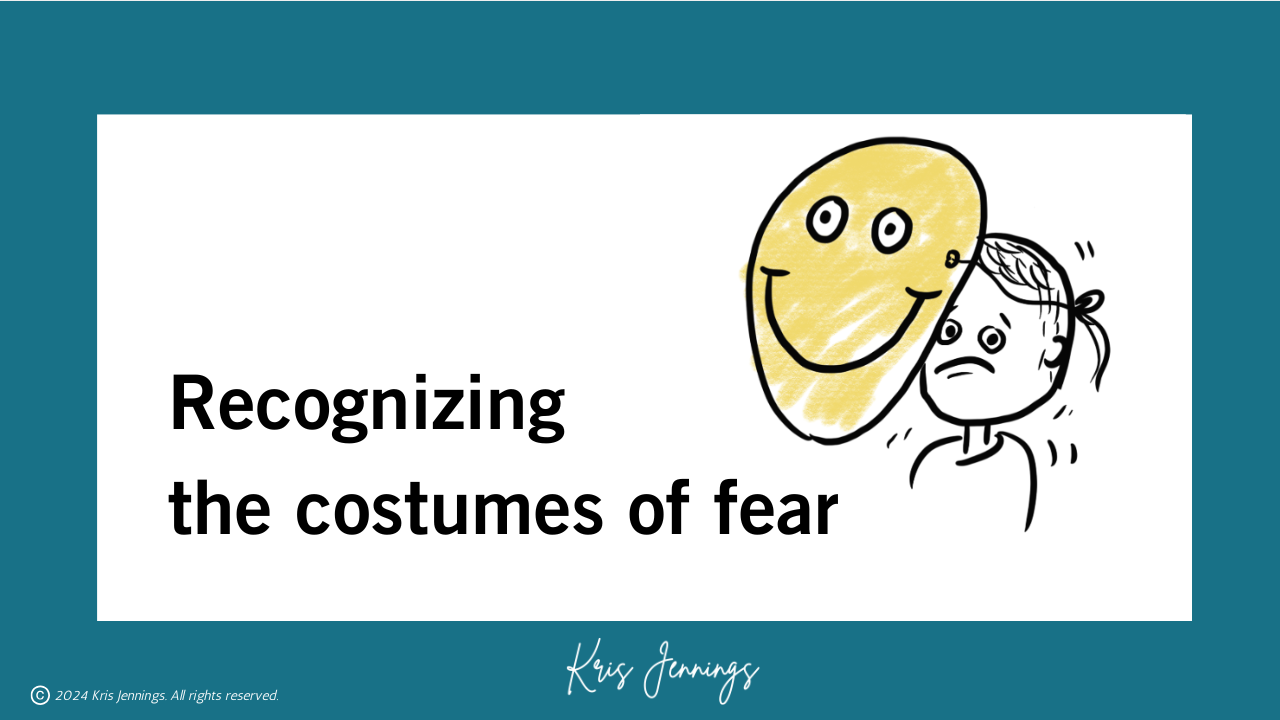
Pretending doesn't make the fear go away
Aug 15, 2024At some point during transformational change, leaders inevitably hit that moment of fear: Can we do this? Can I do this? Is this even possible?
Some leaders choose to put on a brave face and pretend everything is fine. It's an understandable instinct. Who wants to look unsteady in front of their team? But this "fake it 'til you make it" approach is more costly than it looks. It doesn't make the fear go away. It just makes it invisible, and invisible fear doesn't stay contained. It leaks out sideways, in your tone, your pace, your patience, and your team feels it, whether or not you name it.
Making it safe to feel fear
Leaders set the example for others during change, for better or worse. When a leader acknowledges their own fear and uncertainty, it gives the team permission to do the same. That's not a soft, feel-good gesture. It's one of the most concrete behaviors a leader can model during transformational change, because it's the foundation of psychological safety.
Harvard Business School researcher Dr. Amy Edmondson, who has spent over two decades studying this, defines psychological safety as a shared belief that the team is safe for interpersonal risk-taking—that people won't be punished or humiliated for speaking up with ideas, questions, concerns, or mistakes. Her research found something counterintuitive: psychologically safe teams report more errors, not fewer, because people feel safe enough to surface them early, while they're still small and fixable.
That's exactly what change needs. A culture of psychological safety accelerates problem-solving and collaboration, because only when issues and risks are out in the open can they be addressed. And only when team members trust each other enough to be candid can new ways of working actually take hold.
This starts with a leader showing what it looks like to feel fear and talk about it. When a leader says, "I'm nervous about this. I'm not sure I have this all figured out. Can you help me?", it does something subtle but powerful: it tells everyone else in the room that voicing a concern won't get them labeled as negative, difficult, or "not a team player." Research on leader vulnerability backs this up. Leaders who are willing to be appropriately vulnerable build trust faster, because vulnerability signals that it's safe for others to be vulnerable too.
Leaders hold both the power and the responsibility for setting a tone of openness. That tone is built one moment at a time, including the small moments where a leader could pretend, and chooses not to.
When fear wears a mask
More than any other emotion, fear is the one most likely to derail change. Not because it's more powerful than anger or sadness, but because it's the one leaders are most likely to hide.
Fear is a natural reaction to uncertainty. Yet many organizations and leaders don't make room for it. When people sense it's not okay to show what they're feeling, they don't stop feeling it. They just stop showing it. And what gets shown instead is often a disguised version of fear, wearing the mask of something else entirely.
I've written before about the 4Fs of fear at work: fight, flight, freeze, and fawn. The same underlying fear can show up as a sharp comment in a meeting (fight), quietly checking out of a project (flight), endless analysis without a decision (freeze), or going along with everything to avoid conflict (fawn). All four are fear in costume.
At the level of the stories we tell ourselves, fear during change often sounds something like:
- "I hate change. I like how it is now. I'm going to keep doing things the way I always have." (fight, dressed as principle)
- "I'm no good at change. Why bother trying?" (freeze, dressed as realism)
- "They're out to get me. I don't deserve this. I'm going to make this hard for them." (fight, dressed as justice)
- "They better make this easy for me. I'll wait for them to tell me what to do." (fawn or freeze, dressed as patience)
None of these stories announce themselves as fear. That's the point. We avoid naming the underlying emotion because we don't want to be labeled a "change resistor" or a complainer. So instead, we wear the pretend-it's-fine mask. The one that keeps others at arm's length, and that, ironically, leaves us feeling more disconnected from our colleagues, our leaders, and ourselves.
The leader's own fear signal
Here's the part that's easy to miss: leaders aren't exempt from any of this. Leaders feel the chest-tightening, throat-drying, half-step-backward version of fear, too. Often in the exact moments that matter most, like when someone asks a hard question in front of the whole team.
I told a version of this story through my fictional change leader Cera Day in The meeting where Cera almost lost the room. When a team member asked her a direct, fair question about why a restructure was happening, Cera felt her body brace to defend. The half-second pause she found—just enough space to notice the signal before reacting to it—changed the entire meeting.
That gap between trigger and response is exactly where "pretending" and "acknowledging" diverge. Pretending skips straight to the polished answer. Acknowledging starts with noticing what's happening in your own body first.
Notice and name it to tame it
The most reliable way to turn an instinctive fear reaction into a conscious response is to notice it and name it.
Putting words to an emotion measurably reduces its intensity. A UCLA study on "affect labeling" found that naming a feeling lowers activity in the amygdala (the brain's alarm system) and increases activity in the prefrontal cortex (the part of the brain responsible for clear thinking). And if we let it, an emotion runs its physiological course in roughly 90 seconds, according to neuroanatomist Dr. Jill Bolte Taylor's well-known 90-second rule.
If we try to avoid, deny, or override the emotion instead, the mind hits "replay". We're repeating the story about what's happening, which is exactly how fear gets stuck rather than processed. I describe this Notice-Name-Nudge sequence in more detail in How to talk about emotions at work: The 3N Influencing Technique, and it works the same way whether you're using it on your own fear or helping a team member work through theirs.
What this looks like in practice: 5 things leaders can do
1. Name your own uncertainty out loud—on purpose, not as a confession. There's a difference between spiraling in front of your team and modeling honesty. Try: "I want to be straight with you—I don't have this fully figured out yet, and that's part of why I want your input." This isn't weakness. It's an invitation, and per Edmondson's research, it's one of the clearest signals a leader can send that speaking up is welcome.
2. Build in the pause before you respond to a hard question. When you feel the chest tighten, the dry throat, the urge to defend—that's information, not instruction. A breath's worth of space, like Cera's half-second, is often the difference between a defensive answer and a trust-building one. Try: "That's a fair question. Let me think about how to answer that well rather than reach for a quick response."
3. Use Notice-Name-Nudge with your team, not just yourself. When you sense fear behind a comment—even one that sounds like cynicism or pushback—try naming the category gently: "It sounds like there's some real uncertainty here about what this means for the team. Is that fair?" Naming it for someone else does the same thing it does for you: it takes some of the charge out of the moment and opens the door to a real conversation.
4. Watch for the 4Fs, not just "resistance." Before labeling pushback as resistance, ask what fear response might be underneath it. A sharp comment (fight), a sudden quiet (flight or freeze), or someone agreeing to everything with no real engagement (fawn) can all be fear, looking for an exit. The response—and the support someone needs—is different for each. The 4Fs breakdown is a useful field guide for telling them apart.
5. Protect your own capacity to keep doing this. Modeling vulnerability and staying regulated under pressure is sustainable only if you're not running on empty. If you're depleted, your team feels it—your tone, your patience, the energy you bring into the room, whether you intend it or not. Recovery isn't a reward for finishing walks through a simple practice for building that capacity back in, even mid-change.
More important than fear
Like all emotions, unexpressed fear has more power to influence what we do. During change, it can keep us holding onto the past or anxiously bracing for the future. Leaders who learn the simple, repeatable behavior of noticing their fear and naming it—out loud, in real time—take back some of that power. In the process, they give everyone around them permission to do the same.
That's what courageous change leadership actually looks like: not the absence of fear, but the decision to act anyway, because something else—the people you lead—matters more.
If fear shows up for someone on your team as a freeze, rather than a fight, that's its own pattern worth understanding. I cover it in Asking for help when overwhelmed by fear. And if you want the bigger picture of how fear fits into the broader emotional arc of change, The big 4 emotions of the change curve lays out the full pattern: Fear → Mad → Sad → Glad.
Take the next step: Bring this message to your organization
Help your team shift from reacting to change to responding with clarity and courage.
Book a keynote on emotional intelligence and navigating change with courage. Your team will learn to recognize fear responses, apply the 3N Influencing Technique, and build the psychological safety that change requires. Learn more about keynote speaking services.
For leaders seeking deeper exploration, read my book Inspired by Fear: Becoming a Courageous Change Leader, where I dedicate a full chapter to mapping your own fear signals and using the 3N Influencing Technique during organizational change. Buy the book.
Updated June 2026 to strengthen the research base, correct citations, and connect to related articles on the emotions of change.
