
When failure is success
Nov 10, 2022In nearly every organization I've worked in, the same thing is true: there are dozens of significant changes happening at once. Employees are overloaded, overwhelmed, and overworked.
The response from leadership is almost always the same. "We have to get this project implemented. Failure is not an option."
Until failure becomes the reality.
The warning signs are behavioral
When a project team is understaffed, the warning signs show up long before the missed go-live date. You can see them if you know what to look for.
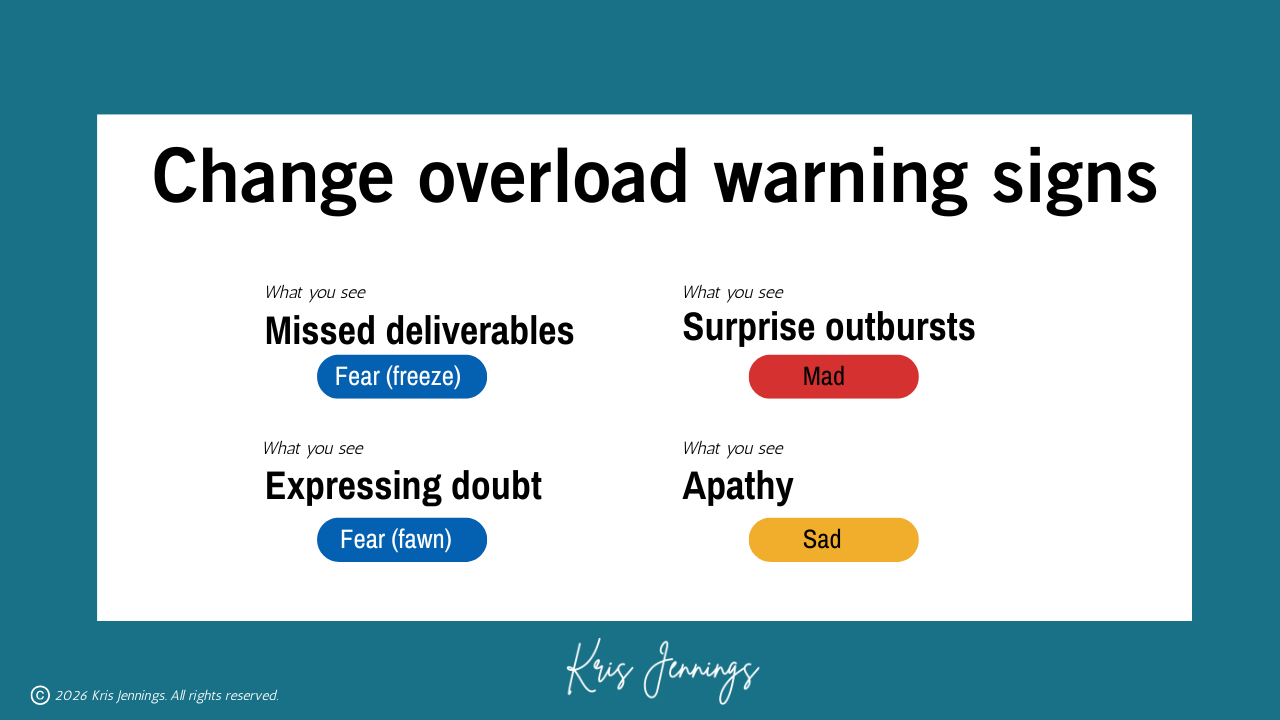
- Missed deliverables. Not from lack of effort. People are stretched across too many competing demands, and something has to give.
- Apathy. Low attendance at meetings, low engagement when people do show up. This is Sad in its most visible form: going through the motions with no energy to spare.
- Doubt. Conscientious employees begin raising concerns about whether the team can actually deliver. This is Fear talking. Not the loud, combative kind. The quiet kind that shows up as freeze or fawn — apparent compliance in the meeting, real resistance outside of it.
- Frustration. Surprise outbursts. Negative comments that catch people off guard. This is Mad: the signal that people feel unheard, overextended, and out of options.
These are not performance problems. They are behavioral signals, and they are telling you something important about the state of your team.
What the timeline slip is actually telling you
When the go-live date gets pushed, it feels like failure. There is embarrassment, often blame, and the question of what went wrong.
Here is what I know after three decades doing this work: the slip is often the healthiest thing that could have happened.
It takes real courage to raise the red flag. Most teams can't sustain the pressure long enough to get someone to listen. When the timeline slips, it means the warning signs finally broke through. That is not failure. That is the organization's self-correction mechanism working.
The failure would have been pushing through, burning the team out, and arriving at go-live with an exhausted, disengaged group of people who have nothing left to give and no capacity to support adoption once you get there.
The leadership brand moment
When the timeline slips, leaders have a choice.
They can treat it as a problem to be managed: find the accountability, tighten the plan, and push harder. Or they can treat it as information. A signal that the original plan did not account for what the team could actually sustain.
Leaders who choose the second path do something harder and more valuable. They pause. They ask what the warning signs were telling them. They get realistic about workload, capacity, and what a sustainable path forward looks like.
That pause is a leadership brand moment. It is visible to everyone on the team. It signals that this leader reads the room, values the people, and is willing to make a hard call in service of a better outcome.
It also builds the psychological safety teams need to raise the red flag earlier next time, before the timeline slips for anyone to listen.
What "doing it differently" actually means
Embracing the failure is not about lowering standards. It is about designing for reality.
When you can read behavioral signals — Fear, Mad, Sad, Glad — as data, you can intervene before the missed deliverables pile up. You can resource realistically. You can protect people's capacity. You can build change that actually sticks because the people implementing it are still standing at the end.
Failure is a good teacher. The question is whether leadership is paying attention.
Update note: This post has been refreshed to connect the original warning signs to the behavioral science lens that underpins the changecapable method. The core idea has not changed.
Ready to build this kind of change leadership capability on your team? The changecapable Leadership Program equips leaders with the behavioral fluency to read the room, resource realistically, and lead change that actually lands. Learn more about the program here.
Photo by the blowup on Unsplash
